Company Carbon Footprint
 Scope 3 Food & Drink
 Product Carbon LCAs
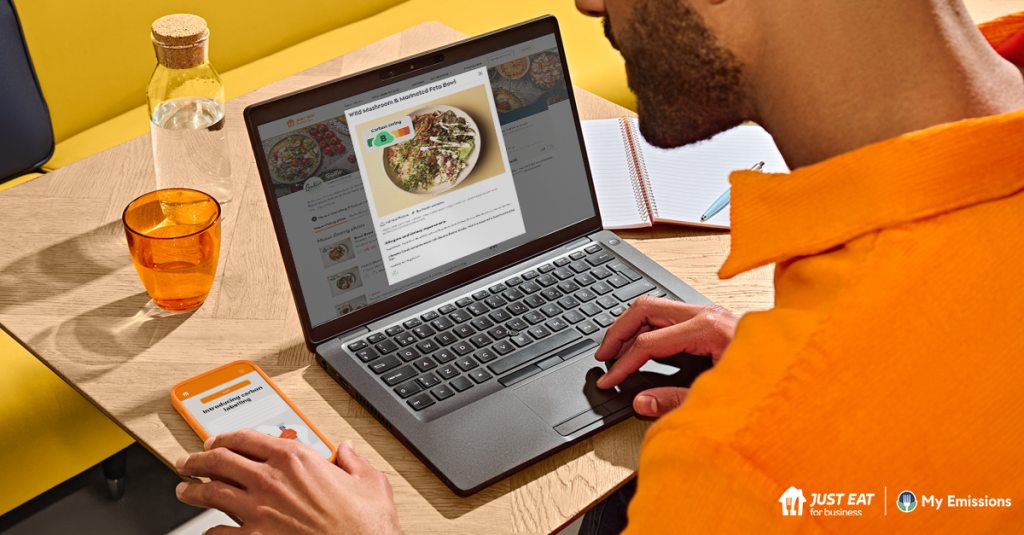
 Menu carbon labelling
 Platform Integrations
 Foodservice and hospitality
 Wholesale
 Manufacturers, brands, producers


Case Studies
Case Study
How UEFA and Just Eat carbon labelled every menu at the 2025 UEFA Finals and Women’s Euros

In 2025, Just Eat Takeaway.com and UEFA expanded their work on sustainable food choices at live sport, bringing carbon labelling to every domestic UEFA final and all UEFA Women’s EURO 2025 matches. My Emissions powered the programme, enabling carbon data to sit directly alongside food choices at scale. The initiative reached hundreds of thousands of fans in stadiums and millions more through digital channels.
This case study outlines the key challenges, outcomes, and how this was achieved.
The challenge: Taking carbon labelling beyond a single pilot
In 2024, UEFA and Just Eat piloted carbon labelling with My Emissions at the Champions League Final at Wembley (read our 2024 case study here). Following the successful pilot, Just Eat and UEFA wanted to scale carbon labelling across as many venues, caterers and competitions as possible.
This introduced three key challenges. First, menus change constantly across stadiums, events and countries, making manual carbon calculation impractical. Second, the solution needed to work with existing catering workflows, without adding operational burden for site teams. Third, carbon data had to be credible and consistent across dozens of matches, while still being quick to deploy.
The solution: Using AI to deliver carbon labels at event scale
My Emissions worked with Just Eat, UEFA and stadium caterers to deliver a scalable approach to recipe level carbon measurement and labelling.
At the centre of the programme was My Emissions’ AI Recipe Generator. This estimates a dish’s carbon rating from just its name. Caterers then reviewed and adjusted these recipes where needed, ensuring accuracy while avoiding weeks of manual data entry.
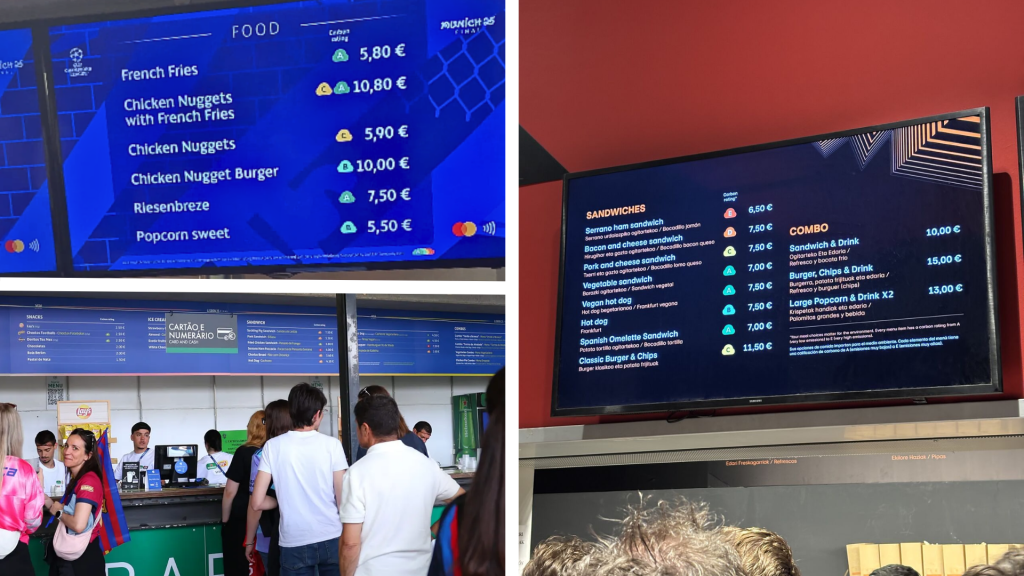
This approach allowed carbon labels to be rolled out quickly and consistently across multiple competitions and venues. Carbon ratings were presented using My Emissions’ simple A to E label, making the data easy to understand for fans and practical for caterers to act on.
Alongside labelling, My Emissions worked directly with catering teams to review menus and identify practical changes to reduce emissions, without affecting quality or fan experience.
What this looked like in practice
In 2025, carbon labels were delivered across:
- Four domestic UEFA finals
- All 31 matches at the UEFA Women’s EURO 2025 fixtures in Switzerland
The programme covered events such as the UEFA Champions League Final in Munich, the UEFA Europa League Final in Bilbao, and the UEFA Women’s Champions League Final in Lisbon.
At selected venues, caterers also used My Emissions insights to adjust menus ahead of kick off. For example, at the Champions League Final in Munich, the catering team reduced average menu emissions by 8.9%, through changes such as increasing plant based options and rebalancing meat content in popular dishes.

The impact: Turning small food choices into visible action
The expanded programme made carbon data part of the matchday experience for fans, while giving caterers clear, practical guidance on how to reduce impact.
To support behaviour change, My Emissions worked with partners to develop clear impact statistics that translate abstract emissions data into everyday comparisons. One example showed that if 1,900 fans chose a chicken burger instead of a beef burger, the emissions saved could be equivalent to powering a stadium for a full ninety minutes.
These messages appeared across matchday materials and partner channels, helping connect individual food choices with collective impact.
Looking ahead
Building on the success of 2025, the partnership has established a repeatable model for bringing food carbon transparency to live sport. As expectations grow from fans, sponsors and organisers, this approach provides a blueprint for how large scale events can embed sustainability into everyday decisions, without adding complexity for teams on the ground.
Read more case studies:
-
-
Case Studies News
-
Case Studies